“Demand creation and clean flexibility can materially reduce curtailment, lower system costs, and deliver wider economic and social value.” (pg 59)
One of the most frustrating features of today’s electricity system is that, at times of high renewable generation in Scotland, we pay Scottish wind farms to reduce their output whilst simultaneously turning up generation elsewhere in Great Britain. And we do that when there are opportunities to make good use of that power in Scotland.
This process, known as constraint management, is becoming increasingly important as renewable generation grows and power flows across the transmission network become more challenging to manage.
The costs involved are substantial. Constraint costs have risen rapidly in recent years and the issue has become so important that it now forms one of the three pillars of the UK Government’s Reformed National Pricing (RNP) Delivery Plan which commits to further bearing down on network constraint costs.
Yet much of the debate still focuses on how to minimise balancing costs within the existing framework, rather than asking a more fundamental question: could we manage constraints in a way that creates wider value for consumers, businesses and society?
The report argues that constraint management should evolve from a relatively narrow set of activities, based primarily on the use of the Balancing Mechanism, into a strategic tool that supports electrification, industrial decarbonisation, economic development and the growth of clean flexibility. It proposes a target model that is better able to bring forward demand creation and clean flexibility as constraint management tools.
A different objective
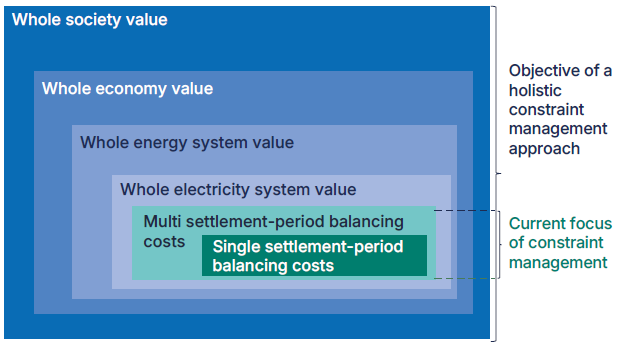
The report starts with a simple observation: the role of the electricity system is not to minimise balancing costs. Its role is to deliver value to society and the economy.
Today’s arrangements place significant emphasis on minimising balancing costs within individual settlement periods. While that objective is understandable, it does not fully capture the wider benefits that demand creation and clean flexibility can provide.
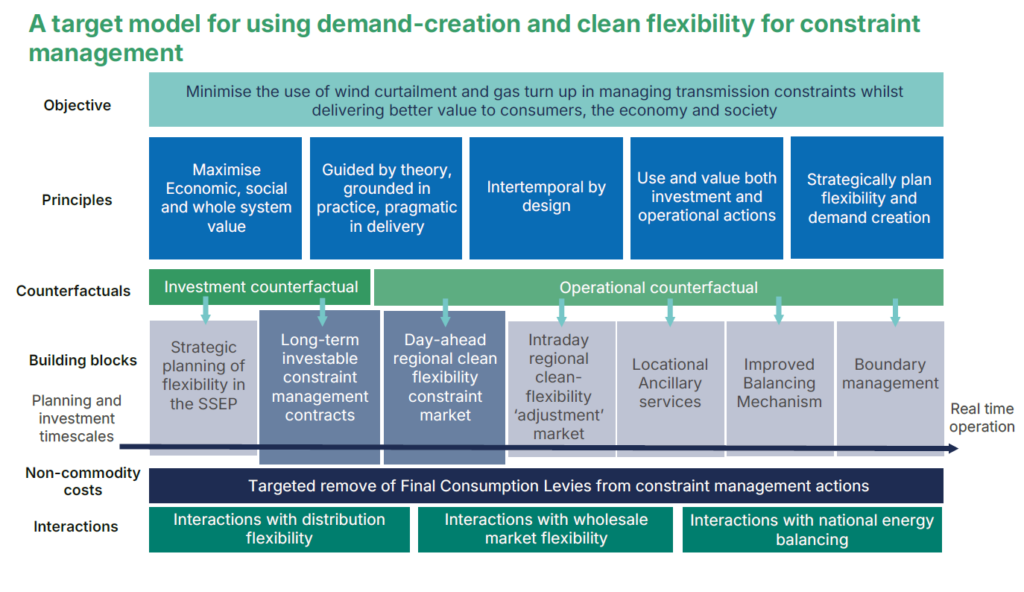
The proposed target model therefore adopts a different objective: maximising value to the energy system, the economy and society, while relegating renewable curtailment and fossil fuel turn-up to actions of last resort.
That requires a different way of thinking about flexibility. Many clean flexibility assets are intertemporal: their value depends on how they operate across time. A battery can only discharge if it has previously charged. Flexible EV charging needs to ensure vehicles are charged when drivers need them. Thermal storage must be managed across hours or days. Constraint management therefore cannot be designed only around individual settlement periods. It needs mechanisms that can schedule assets across time.
The target model is built around five principles:
Maximise economic, social and whole-system value. Constraint management decisions should consider wider impacts on decarbonisation, fuel poverty, industrial competitiveness and economic growth, not just short-term balancing costs.
Be guided by theory, grounded in practice and pragmatic in delivery. The best theoretical answer is not always the most investable, operable or deliverable one. Reform needs to be practical, phased and capable of building confidence.
Intertemporal by design. Markets and dispatch processes should optimise across multiple periods, particularly where batteries, thermal storage and demand time-shifting are involved.
Use and value both investment and operational actions. Some of the biggest benefits come not from dispatching assets differently tomorrow, but from encouraging new demand and flexibility to locate in the right places over years and decades.
Strategically plan flexibility and demand creation. Flexibility should be treated as a core part of the future electricity system, alongside generation and networks.
Demand creation and clean flexibility: two tools that can deliver value
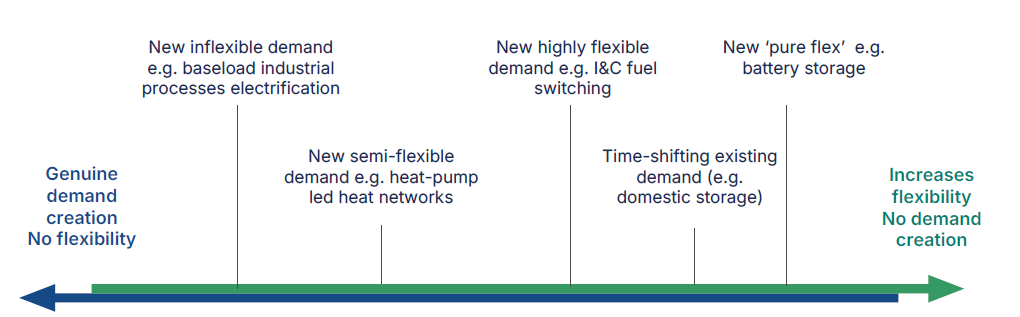
A key theme of the report is that demand creation and flexibility are related, but different.
Demand creation is about increasing the amount of electricity that society uses in the first place. Electric vehicles replace petrol cars. Heat pumps replace gas boilers. Electric boilers replace fossil fuel industrial heating. Electrolysers create demand for electricity to produce hydrogen. Data centres create entirely new sources of electricity demand.
Flexibility is about changing when electricity is used. Batteries, demand-side response, thermal storage and other flexible technologies can shift consumption from one time to another, helping the system respond to constraints when they occur.
This distinction matters because many of the largest benefits arise not from shifting existing demand, but from accelerating wider electrification. Every additional unit of electricity demand located behind a constraint can permanently reduce the amount of renewable generation that needs to be curtailed.
Of course, ensuring that demand creation is flexible adds further value, and we should build in flexibility where possible. But in the first instance, behind a constraint, particularly one as significant as the constraints affecting Scotland today, additional demand is likely to help.
In other words, electricity demand creation is a critical part of reshaping the energy system itself, while flexibility helps us operate it more effectively.
Building a new model
To turn these principles into practice, the report proposes seven building blocks.
These include strategic planning of flexibility requirements within the Strategic Spatial Energy Plan, long-term investable contracts, day-ahead and intraday constraint markets, locational ancillary services, improvements to the Balancing Mechanism and better management of network boundaries.
Two building blocks are particularly important:
The first is long-term contracting. Some forms of demand creation and flexibility require significant upfront investment and cannot rely solely on short-term market signals. Long-term contracts can provide the confidence needed to invest in assets that deliver system value over many years. This is particularly important in supporting the faster electrification of the energy system – a wider priority for the energy transformation.
The second is the creation of day-ahead constraint markets. Today’s arrangements remain heavily dependent on the Balancing Mechanism operating close to real time. The report argues for forward markets that can optimise flexibility over multiple hours and enable a much wider range of participants to contribute.
Why Final Consumption Levies matter
One practical barrier to using demand to replace renewable curtailment is the treatment of non-commodity electricity costs.
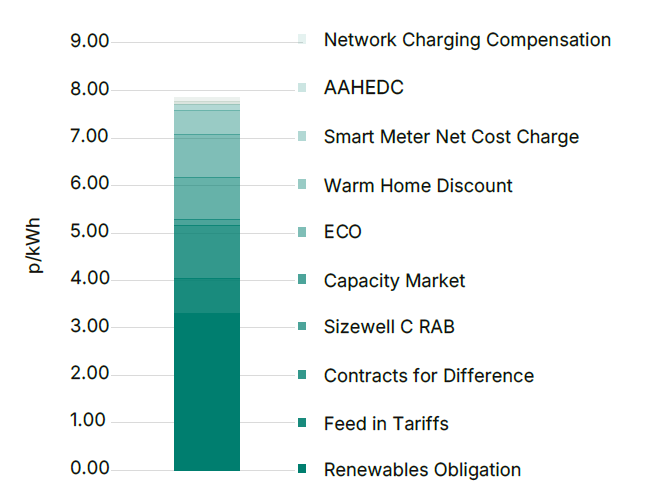
Final Consumption Levies (FCLs) recover the costs of government policy schemes such as Contracts for Difference, the Renewables Obligation and the Capacity Market. These levies are generally applied to all consumption of electricity as measured by a customer’s meter. That includes electricity used to help balance the system or provide other benefits, such as constraint management. They mean that final consumption of electricity can be substantially more expensive than alternative fuels, even when that electricity would otherwise have been curtailed.
For example, a distillery, industrial site or heat network may be willing to consume otherwise-curtailed electricity, helping avoid wind curtailment and supporting wider system outcomes. But even if the electrical energy itself is provided for free to the consumer, the price signal can be as much as £80/MWh higher because of FCLs. There are also other non-commodity costs, such as contributions to the cost of distribution and transmission networks, that final consumers may need to pay.
The report therefore recommends targeted removal or rebate of FCLs for electricity used specifically as part of constraint management. This is not a general subsidy. It is a way of aligning electricity prices with system value.
Recognising interactions across the system
Transmission constraint management does not operate in isolation from other ways in which demand creation and clean flexibility can benefit the system. Flexibility is also valuable in several other areas:
Helping balance the GB-wide wholesale energy market through arbitrage.
Providing national balancing services, such as frequency response and reserve, that do not depend on location and are procured by NESO.
Helping manage distribution network constraints and other local network issues through the growing role of distribution-level flexibility markets.
Future arrangements need to complement these markets, not conflict with them. They also need to work alongside Active Network Management and other local controls, so that actions taken at transmission level are not unintentionally offset elsewhere.
In short, constraint management should be viewed as part of a wider flexibility ecosystem.
From balancing costs to system value
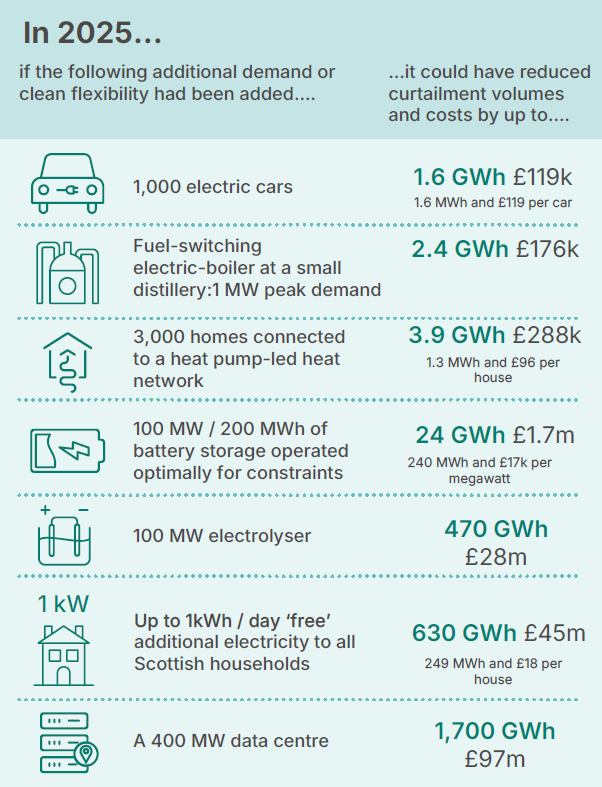
Alongside the target model, we have published an evidence and analysis report which explores what different forms of demand creation and flexibility could have achieved if they had been implemented in 2025, using real constraint data.
That evidence report shows the scale of the opportunity. Interventions ranging from electric vehicles and industrial fuel switching through to electrolysers, batteries and data centres all show the potential to reduce curtailment and lower system costs.
The challenge of constraint management is often presented as a consequence of success in deploying renewable energy. That is true. But it is also an opportunity.
If we can use more of the electricity that Scotland is already generating, we can reduce system costs, accelerate decarbonisation and create wider economic value. The question is no longer whether demand creation and clean flexibility have a role to play. It is how quickly we can build the frameworks needed to unlock them.
I would like to thank Scottish Futures Trust and the working group members who supported this work: Zenobē, Octopus Energy, Connected Response, Vattenfall, SP Energy Networks, Flexitricity, Statera Energy, Eneus Energy and Steen Engine.