
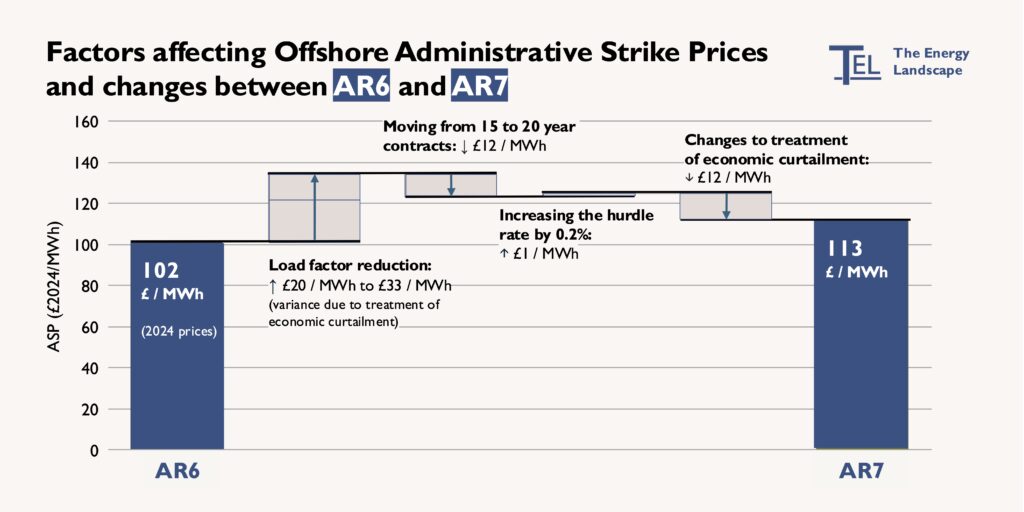
The Administrative Strike Price (ASP) for wind has risen sharply this round. The main driver? It appears to be lower assumed load factors in DESNZ’s modelling — a change that appears to add between £19/MWh and £33/MWh.
Several changes complicate AR6 vs AR7 comparisons:
- Prices are now shown in 2024 terms (so to compare AR7 with AR6 older CfD prices need to be multiplied by ~1.7 ).
- Contract length extended from 15 → 20 years.
- Hurdle rate nudged up slightly.
- Load factors revised down and calculated differently. (Load factor tells us about the energy produced per MW of capacity.)
AR6 assumed a very high offshore wind net load factor of 62%1 (reference available in comments below), already adjusted for outages but excluding “around 5 percentage points” for offshore wind.
In AR7, net load factor drops to 49%2. Both the AR7 methodology note and a new Generation Cost Report Note3 mention tweaks to power curves and loss assumptions, but it’s unclear the degree to which economic curtailment is included. I looked at two scenarios:
a) Economic curtailment fully excluded from the AR7 load factor → effective load factor 44%. (Assumes similar scale and treatment of economic curtailment as AR6)
b) Economic curtailment fully included in the AR7 load factor → effective load factor 49%.
I’ve used the Regen open-source investment model4, holding other AR6 parameters constant:
⬆️ If 44% (Option A), ASP jumps from £102/MWh (AR6 in 2024 terms) to £136/MWh.
⬆️ If 49% (Option B), ASP rises to £121/MWh.
The other changes in AR7 also affect strike prices:
⬇️ the 20-year contract trims ~£12/MWh from the ASP,
⬆️ while the higher hurdle rate adds ~£1/MWh ASP.
Overall
Option 1 would overshoot the published ASPs for AR7 so other big changes, such as a 12% capex cut relative to AR6 would be needed. If Option 2 is correct, the results is in line with the published value.
Conclusions
The extra headroom in ASPs for AR7 seems to stem from a technical correction: reducing optimistic technical load factor assumptions, rather than major shifts in expectation about the underlying costs of renewables.
It would help if DESNZ published clearer details on its modelling helping us all to understand what government thinks is drives changes in key parameters and policy decisions. The AR7 note indicates that there cost modelling may soon be updated, hopefully that provides a little more clarity.
References:
- AR6 ASP Methodology note: https://assets.publishing.service.gov.uk/media/6555dca8d03a8d000d07fa12/cfd-ar6-administrative-strike-price-methodology.pdf ↩︎
- AR7 ASP Methodology note: https://assets.publishing.service.gov.uk/media/6880d6f8f47abf78ca1d3550/cfd-ar7-administrative-strike-prices-methodology-note.pd ↩︎
- Generation Cost Report series, 2025 note on Load factors for renewable wind technologies: https://www.gov.uk/government/publications/load-factors-for-renewable-wind-technologies ↩︎
- Regen Open-Source Wind Investment Model (set up for offshore wind): https://regen-open-data-regengis.hub.arcgis.com/datasets/483f9ed0e4154979a261c8bd7269db6f/about ↩︎