Delivering a clean electricity system depends on new renewable generation in Scotland, but Transmission Network Use of System (TNUoS) charges have long posed a challenge for Scottish generators. Today, the scale, uncertainty, and impact of these charges have increased significantly. They now represent a direct risk to Britain’s energy transition.
Scottish Renewables has published my latest report on Transmission Network Use of System (TNUoS) charges.
Transmission charging has long been contentious for Scotland. The locational methodology results in high charges for generators in the north, while generators in parts of the south receive credits under the same framework.
The scale of the issue is now set to increase dramatically.
By 2030, the annual cost of the transmission network, recovered through TNUoS, is projected to rise from around £4 billion to approximately £12 billion.
That tripling of costs magnifies existing weaknesses in the charging regime and intensifies regional disparities.
At the same time, Scotland remains central to the energy transition, with substantial new renewable capacity required under Clean Power 2030 and strategic plans. New renewable investment is also central to a Just Transition in Scotland, supporting new jobs and green economic growth.
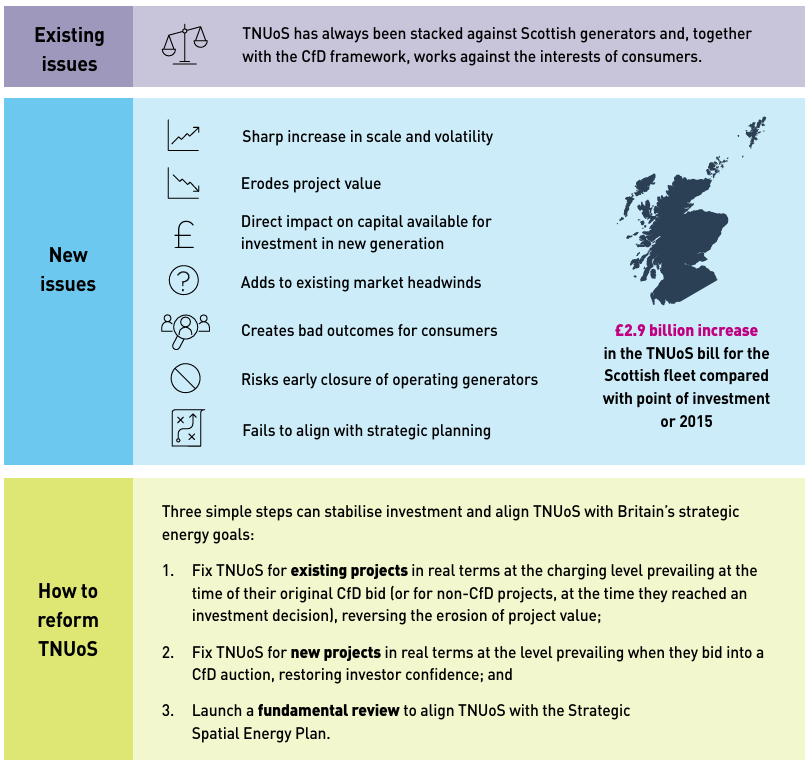
For operational projects and those nearing final investment decision, rising and volatile TNUoS charges erode project value with limited ability to respond. That constrains capital recycling, increases financing costs, and undermines investor confidence.
In some cases, current TNUoS forecasts combined with other headwinds facing the sector could lead to some generators closing early as operating costs – including TNUoS – exceed operating revenues. This would be an incredibly bad outcome in the middle of a move to a decarbonised system.
The most important point is that this is likely to deliver poor outcomes for consumers. In a system built around long term CfDs, increased risk premiums and locational distortions become embedded in strike prices and ultimately flow through to bills.
The report makes several recommendations. The first two are short term reforms to reduce uncertainty, including fixing TNUoS charges for existing and new generators at levels prevailing around the time of their CfD bids.
But those short-term reforms should be a bridge to the third recommendation: a more fundamental rethink of how we fund and price the transmission network in a strategically planned electricity system. We know that Ofgem is planning a consultation on TNUoS in the near future and I hope that considers a sufficiently wide scope for reform.
If we get this wrong, we risk slowing investment where it is most needed and slowing the transition.
I will be talking about the report at the Scottish Renewables Grid Conference in Glasgow tomorrow (26th February). Do come and say hello if you are attending.