
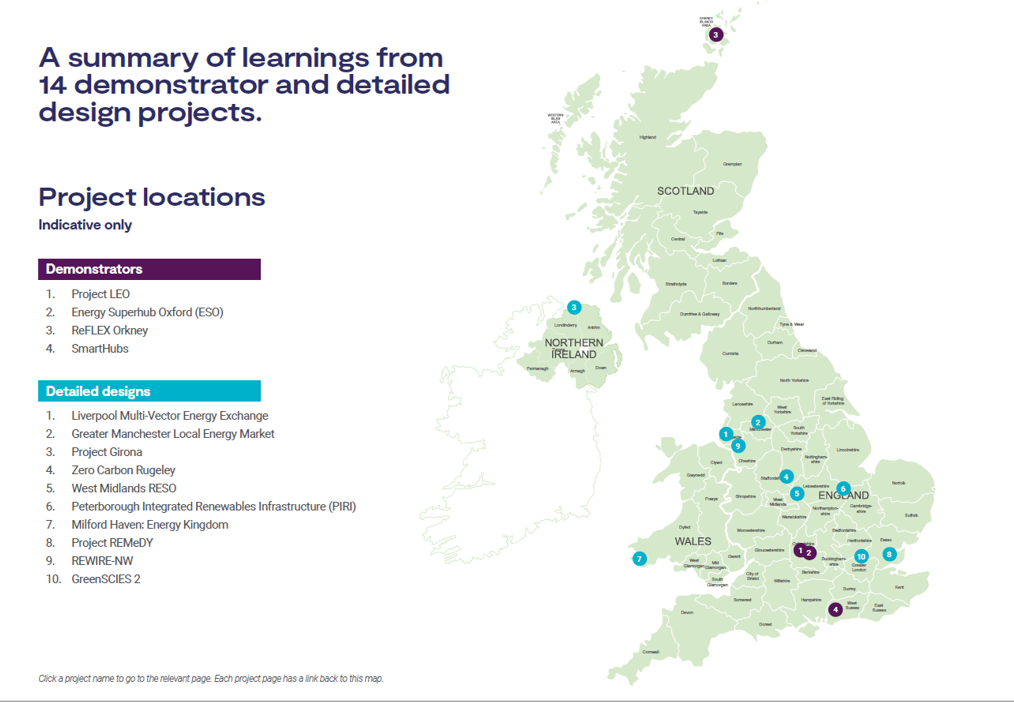
For this project I worked with InnovateUK to review the leading projects from the Prospering from the Energy Revolution (PFER) programme. This groundbreaking programme aimed to demonstrate new, smart and local ways of developing energy systems that could adapt to local opportunities and challenges and benefit local people and communities.
For much of the modern history of the UK the focus on our energy system has been a national one. Decarbonisation is changing that mindset. The growth in renewable generation to supply electricity, the increasing importance of decarbonising heat and transport, and the potential for hydrogen mean that a more regional and local focus is needed to complement that national emphasis. This is also important beyond the energy system: social outcomes such as ensuring fair and affordable access to energy, and economic ones such as realising the industrial and commercial strengths of each region, require a more nuanced, place-based approach to energy. The development of smart local energy systems, embedded in both the technicalities of modern energy and digital infrastructure and in the importance of placemaking, needs to be at the heart of the future energy system. Delivering pioneering local energy projects today is not easy. Policy, regulatory, investment models and skill bases tend to reinforce a national mindset and none are currently set up to support a move to ‘local’. However, demonstrating an integrated place-based approach is important as it provides us with evidence of what can work and what might not and where the biggest benefits and the most challenging barriers are likely to be. It also shows the art of what is possible and supports the development of a wider place-based vision where smart local and smart national systems work effectively together.
This report contains summaries of learning and experience from 14 pioneering projects carried out as part of the Prospering from the Energy Revolution challenge, funded by UKRI and delivered by Innovate UK. It summarises what each of the projects has achieved, the
barriers it has faced and the key points that its partners and stakeholders have learnt. It can provide a starting point for the next generation of innovation projects and act as a launch pad to help new smart local energy ventures to stand on the shoulders of those have already explored the landscape and identified some of the pathways to success.
Common threads
The learning from these projects highlights the complexity involved in delivering smart local energy systems. An effective, integrated local energy system will include a wide range of technologies working cooperatively across multiple energy vectors to deliver numerous outcomes. It will require significant and usually automated communication between different elements of the system and management of significant quantities of diverse data. Most importantly it will interact with a wide range of stakeholders each with their own objectives, capabilities and values.
Previous generations of energy innovation have tended to focus on technological innovation such as the development of new battery technology, or the control algorithm in a vehicle-to-grid charger to manage local network constraints. Although technical innovation have had an important place in this programme’s portfolio, it is striking the degree to which innovation and learning has moved towards other elements needed for a successful smart local energy system. These include the development of novel business models, the importance of investment frameworks to leverage public and private finance, the growing importance of data, and the expansion of our concept of value.