“Enabling consumers to make low carbon choices … will play a significant part in responding to the climate emergency”.
I’ve recently supported Consumer Scotland to produce a framework and toolkit for policy makers. Over several months I worked with the brilliant CS team to explore what good consumer outcomes look like for the climate transition, how tensions should be balanced, and how to lay out a framework to support government decision making.
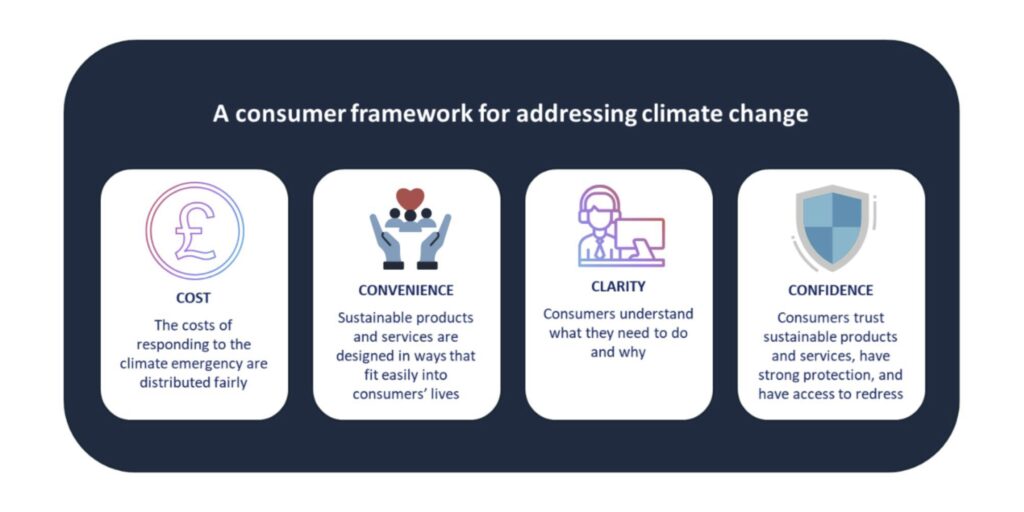
From those four Cs we went on to defined seven outcomes (see table below). Here are a few of my reflections on the outcomes:
1 – Government leadership
This seems to be critical. Government needs to provide compelling and consistent narratives and help each stakeholder to understand their role. Today, I feel that leadership is being lost.
2 – A well-planned transition
The consumer journey, rather than the techno-economic modelling, needs to be the driving factor that sets the strategy. If an approach to decarbonisation doesn’t work for real people, it doesn’t matter if a model says it is the ‘cheapest option’.
3 – Appropriate and sustainable choice
Increased consumer choice is often an ambition. However, in the face of the climate crisis, more choice isn’t always an option, nor is it always desirable. One phrase I learnt from the CS team was ‘Choice or Voice’: the more choice is limited, for whatever reason, the stronger the consumer voice needs to be in shaping what is on offer.
4 – Empowered consumers
Recent CS research say “three quarters of Scots are concerned about climate change, but less than a third said they know a lot about what they need to do”. That needs to change!
5 – Decisions are fair
In other work I’ve done I’ve heard wildly differing views of what fair means (from fair as ‘cost reflective’ to fair as ‘equality or equity of access’). This framework suggests a definition for fair that is: “decisions are fair because they share costs and benefits appropriately and work to reduce inequalities”. That’s a definition I like!
6 – High levels of consumer trust
Building trust is foundational to a successful transition. Policy making often assumes that consumers will shift how and what they consume – but we actively need to build that trust.
7 – Trade-offs are balanced honestly
This is about grown-up decision making. The climate transition will create trade-offs, we can’t pretend that everything will be perfect for everyone. And for that we need honesty.
For me the bottom line is that Government needs to step up its leadership on the climate transition. As Sam Ghibaldan, CS Chief Exec says of the framework: “Our research shows that consumers expect key decision-makers to lead the way”.
Table from figure 2 of the Consumer Scotland report, outlining the seven outcomes
Consumer outcomes for placing consumer support and participation at the centre of our national response to climate change
Governments provide leadership that is ambitious but also realistic, consistent and inspires change
The transition is well planned, based on credible targets, delivery-focussed and consumer-orientated
Appropriate and sustainable choices are available for all, reflecting both the climate emergency and the needs of consumers
Consumers are empowered because they are enabled to engage with the transition
Decisions are fair because they share costs and benefits appropriately and work to reduce inequalities
High levels of consumer trust in the need for change, the impact of acting, and the protections available
Trade-offs are balanced honestly by acknowledging that we all face competing priorities