
This project explores the question of how much capacity on the national, main transmission network is economically efficient given the likely capacity, type and spatial distribution of generation and the magnitude and location of demand in a decarbonised electricity system. It has been undertaken through a partnership between the University of Strathclyde, the Offshore Renewable Energy Catapult, and The Energy Landscape.
The project explores some important consequences of our transition to a decarbonised electricity system, an ambition which the previous UK Government before the July 2024 General Election had targeted to achieve for 2035 [1] and which the new Government now aims to deliver by 2030 [2].
Networks play two important roles in the electricity system. Firstly, they allow the electricity market to operate efficiently, meaning that buyers of electrical energy can choose between generators wherever they are located, and ensures the cheapest available generation or flexible assets such as energy storage can be dispatched to meet demand. Secondly, they ensure a secure supply of electricity across the country by allowing different regions to share back-up, reserve generation. Any network has a limited capacity. When and where a network’s limit is reached, its ability to play those roles is restricted, which manifests as costs: a less efficient, more expensive, dispatch of generation; and, potentially, reduced security of supply.
Today, our limited transmission network capacity is most often discussed in terms of the curtailment of wind generation. Capacity limits between the north and south of Great Britain (GB) mean renewable generation in Scotland and northern England are often curtailed off and replaced with more expensive, higher carbon generation in the south. From the perspective of the production of electrical energy, curtailment is an operational inefficiency. It means that the cheapest generation cannot be used. Put another way, it means that the full value of investment in offshore wind, onshore wind and other renewables cannot be realised.
Given the importance placed on renewable generation and particularly on offshore wind, there is now a strong focus on investing in the GB transmission network to ensure that northern renewable generation continues to deliver value across the country. However, networks are not free, nor are they easy or quick to build. There are significant investment costs and, as in any infrastructure system, there will be a trade off: investment in network infrastructure should be balanced against reductions in the cost of operating the electricity system, reduction in emissions, and against the additional value it creates through greater confidence of secure supplies.
There is widespread agreement that we will need significantly more transmission network capacity in order to reach that balance point under any scenario which gets close to delivering a decarbonised electricity system in the 2030s. But questions remain: how much more network capacity do we need? By what date? And how should we assess the level of need?
Key Messages
- The scale of change we expect to see in the electricity system over the next 10-15 years has not been seen since at least the 1960s, and in order to deliver a decarbonised electricity system 2035 at the latest, change needs to be fastest during the next decade.
- Residual demand is negative for much of the time in a net zero system.
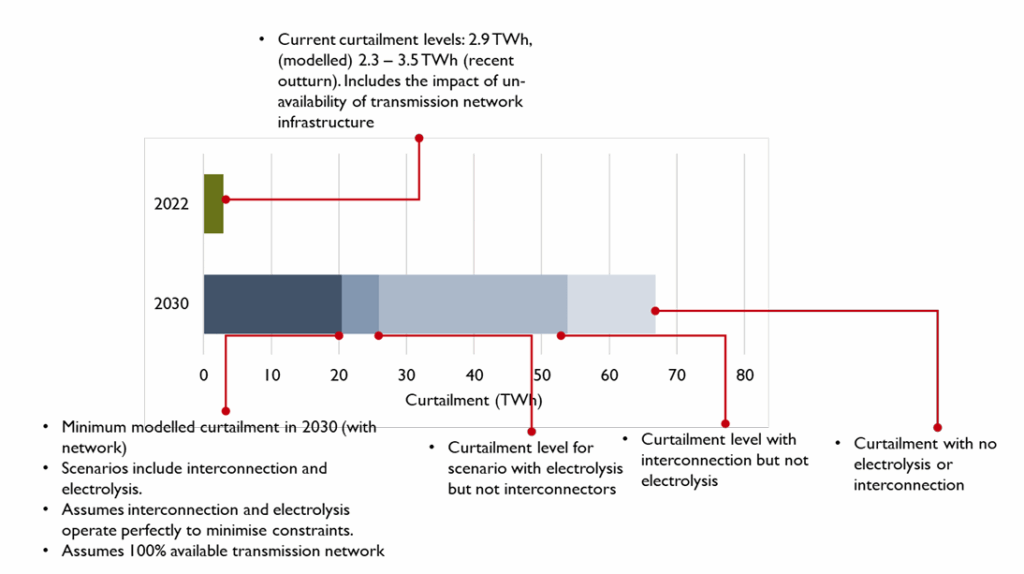
- Curtailment of renewables, including offshore wind, is likely to grow significantly by the 2030s even with planned transmission network reinforcements.
- By the 2030s, curtailment won’t just be caused by transmission limits but also national ‘energy balance’ constraints: the inability, at certain times, to use all the available renewable energy within GB at all or to export or store it.
- The average distance electricity will travel between generation and consumption is likely to increase significantly over the next few years.
- Absolute peak unconstrained MWkm flows (the largest hourly flow modelled within a year) could increase by a factor of more than three by 2035, but building transmission to facilitate full unconstrained MWkm flows will be impractical and economically inefficient.
- The modelling suggests that the vast majority of current curtailment can be accounted for by network outages.
- Planned investment in the bulk-transportation element of the transmission network will more than double its physical capability by 2040, taking it from 9.0 million MWkm in 2022 to 21.9 million MWkm in 2040.
- For the generation background modelled, results suggest that financial considerations and the impact on renewable curtailment may justify further expansion of the transmission network, beyond current plans.
- Individual network investments are not made in isolation but need to be part of a coherent programme.
- Interconnectors are critical to managing curtailment levels.
- Hydrogen electrolysis represents a potentially significant new and highly flexible demand for electricity.
- Electricity system energy storage (batteries, pumped storage) has a critical role to play in ensuring an operable and secure electricity system.